Mechanical Engineer | Generate Product Development Studio | Sep - Dec 2024
BaselineTech
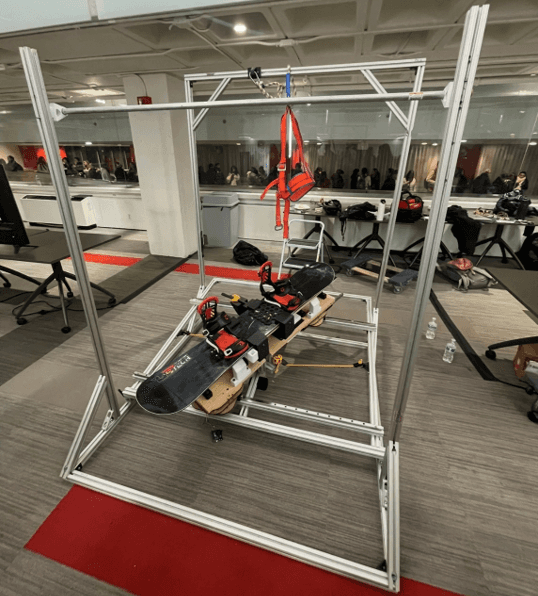
Snowboard simulator replicating the roll, yaw, and pitch of snowboarding
Project Overview
Project Objective & Key Requirements
BaselineTech was a semester-long project with the goal of designing a year-round snowboard training simulator enabling realistic rotational and linear movements for up to 150-200 pound users. The key requirements were:
Simulate 3 rotational degrees of freedom (roll, pitch, yaw)
Accommodate varying snowboard sizes and up to 200 lbs. users
Collect real-time data from sensors throughout system
User-friendly design with integrated safety features


Technical Contributions
Yaw Subsystem
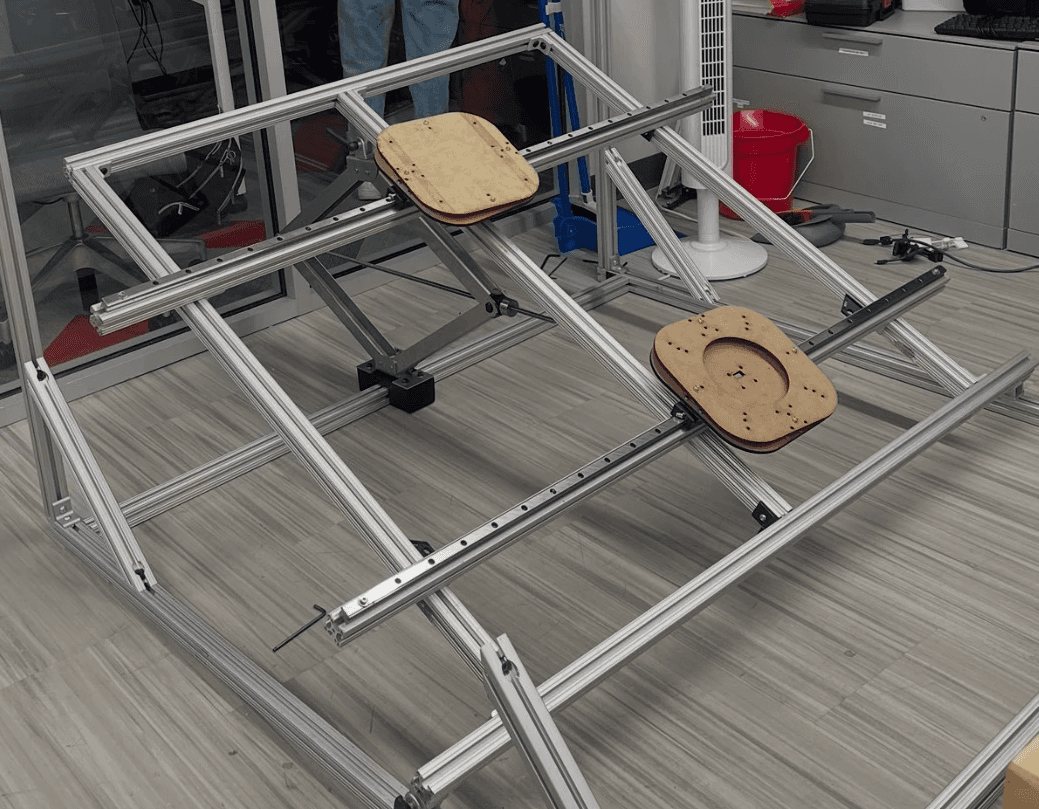
One of the key components of snowboarding is horizontal rotation. My challenge was to enable this movement while accommodating dynamic length changes as the board pivots. I chose to solve this by creating a front and back assembly using large rotational bearings called lazy susans. Below are key design decisions:
Front assembly had 10" lazy susan (130 lbs. load capacity) mounted on linear track
Back assembly had 10" lazy susan with dual 250mm linear rails on a linear track providing rotational freedom with length adjustment needed
Used 1/8" MDF for past iterations and structural integrity with load distribution
Positioned rotary encoder within front assembly for angle measurement
DFM, DFA, Validation
Design for Manufacturing, Assembly, and Validation
Each component was designed to be manufactured on a laser cutter. Since most of the load in each assembly was on the rotational bearing, MDF was chosen as the interfacing material for its strength/durability and cost. MDF allowed for fast iteration cycles.
In terms of assembly, every screw was designed to be reachable when fully assembled. This allowed for easy disassembly when working on a specific part, like installing the rotary encoder and its housing. Sourced all hardware and other components from Amazon and Vevor giving us easy access to additional materials if needed.


Collaboration
Cross-Subsystem Collaboration
Roll Subsystem: Coordinated the mounting surface between the yaw and roll assemblies. Provided extra mounting holes with slots to solve for tolerancing issues. Also mounted yaw assembly to the linear movement.
Electrical Team: Confirmed rotary encoder placement and wire routing for cable management.
Safety: Confirmed yaw range of motion didn't interfere with safety needs and range of motion.
Outcome & Results
Project Outcomes and Future Improvements
In technical terms, the yaw subsystem achieved over 100 degrees of smooth rotation for the user to test changing their weight from the front edge to the back edge. To allow for that rotation, the linear rails mounted on the back assembly successfully compensated for 4-6" length variation during rotation. Non-technically, I was able to keep the total subassembly under $150!