
Mechanical Tech Lead | Generate Product Development Studio | Jan - Apr 2025
Candle Maker
Automatic table top compact candle production machine
Project Overview
Project Objective & Key Requirements
The goal was to create a table-top product designed to simplify and automate the process of making scented candles. The primary users are hobbyists and candle enthusiasts that enjoy making custom candles for personal use or to sell. With this in mind, these key requirements were created:
Produce an 8oz free-form candles
Allow for any scent & wax/blend to be input by the user
Produce a candle in less than 30 minutes
Stay within the $2500 budget


Leadership
Leadership Role & Responsibilities
As a Mechanical Tech Lead, I led a team of four mechanical engineers over a four month development cycle guiding the overall product architecture and design reviews. Personally, I designed three critical subsystems: the structural framework, lifting mechanism, and wick placement subsystem. The most important part of my role and responsibilities was to manage cross-functional integration between mechanical and electrical systems.
Setup
Research & Planning
My research consisted of analyzing industrial and hobbyist candle-making processes to identify key parameters (melting/pouring temperatures, wax properties, safety) and challenges (residue, fragrance control).
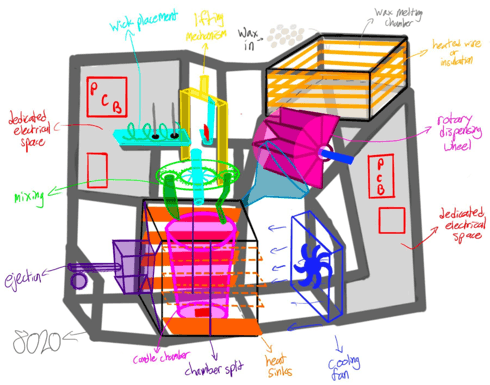
With the research conducted and these parameters, the system architecture was broken into 6 integrated subsystems listed below:
Wax Melting: Heating pot with self-adhesive film heaters
Dispensing: Custom peristaltic pump with temperature-specific silicone tubing
Wick Placement: Magnetic conveyor belt system with decoupler mechanism, routing wick into forming chamber
Mixing: Planetary gear drive with belt-driven ring gear and silicone over-molded scraper
Lifting Mechanism: Lead-screw actuated with linear rail guide to raise/lower mixing and wick placement
Cooling/Ejection: High-temp resin chamber with fans and heat sinks to solidify the wax. Ball screw actuation used to remove the candle


My Contributions
Wick Placement & Lifting Mechanism
In addition to my leadership on the team, I designed the wick placement subsystem and co-designed the lifting mechanism with a fellow engineer.
The wick placement subsystem consisted of a Pololu DC gearmotor with a motor coupler, 3D-printed structures, two pulleys, and a belt with magnets glued on. The motor rotates the belt, and the wicks that are placed on the magnets get detached due to their geometry. The wick then slides down a tube and into the center of the mold where a magnet holds it in place.
The lifting mechanism was built to fit within the tight space constraint and combine the vertical movement needed for the mixing and wick placement subsystems. The assembly consisted of one lead screw and one linear rail to create vertical movement.
Outcomes & Results
Project Outcomes and Future Improvements
In the end, a fully build prototype was delivered to the client within budget. With the plan of a second iteration the following semester, I created a "Do's and Don'ts" document to help with the safety of the machine and DFM optimization. I am also proud of the development of each of my members technical and non-technical skills.
With more time on our side, I would have loved to try a different wick placement design, resembling a vending machine or a rotational dropping mechanism. In addition to that change, the lifting mechanism could have used an additional lead screw or linear rail to improve robustness and stiffness in the assembly. Many adjustments were made across the semester, from redesigning the dispensing mechanism, to working around a team member departing mid-project. In conclusion, this project brought my team and I together and I could not be more proud of our work.


Chicago, morning light — 35mm film

Rooftop, late fall
Steeple study, long exposure
Type study — condensed geometric sans
Ink sketch, studio notebook
Watercolor study, tree line